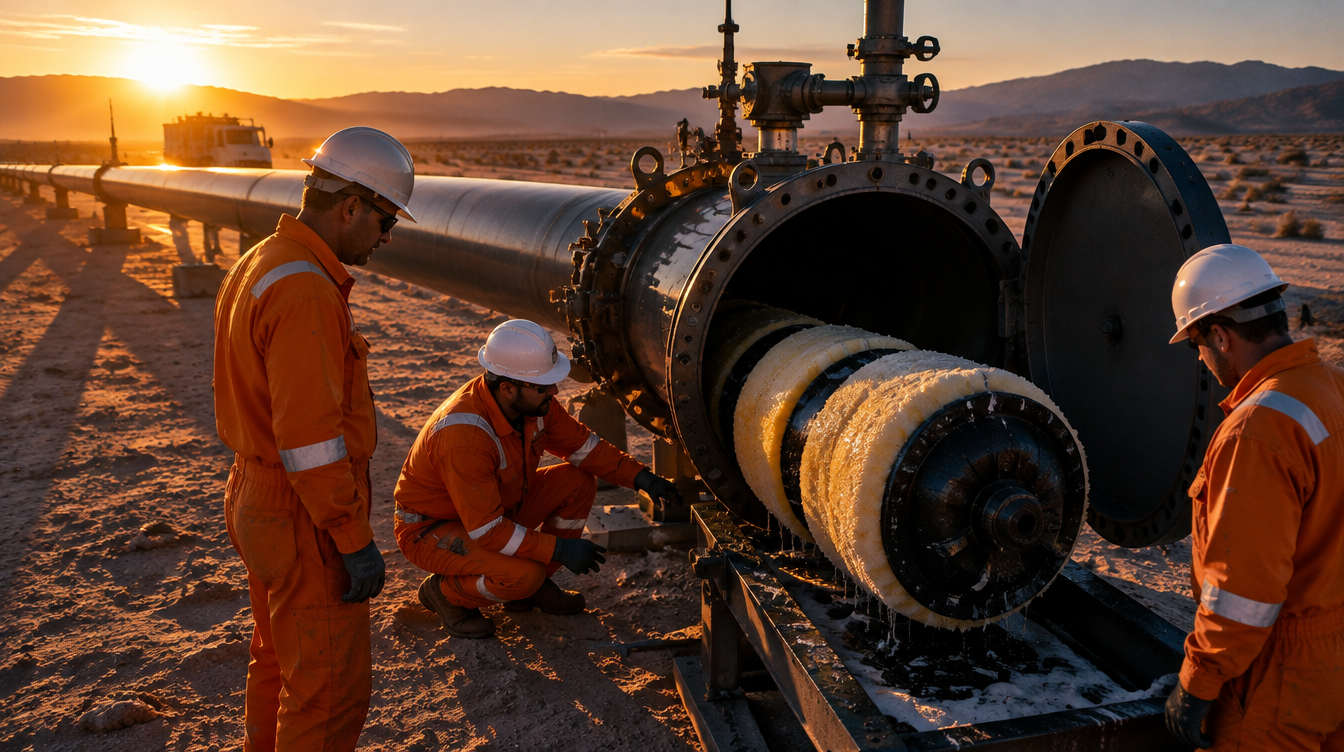
- Pre-commissioning steps run in a deliberate order, and each one prepares the line for the next.
- Debris left after construction can damage valve seats, pumps and in-line inspection tools.
- Residual water drives early corrosion and, in gas service, hydrate formation at start-up.
- The pre-commissioning dossier is the integrity baseline for the life of the line.
A new pipeline leaves construction carrying more than anyone would like: mill scale, weld spatter, sand blown in during stringing, rags and offcuts, and rainwater or test water pooled at low points. None of it shows on the as-built drawings. All of it travels with the first product unless it is removed deliberately, in the right order, and with records that prove it was done.
Pre-commissioning is the work that removes it. Under schedule pressure it is often treated as a box to tick between mechanical completion and first gas. That is a mistake with a long tail. Debris left in a line damages valve seats and pumps, water left behind starts corrosion and, in gas service, hydrates, and a line that was never properly gauged may refuse the first in-line inspection tool years later, just when the operator most needs the data.
The sequence and why it matters
Pre-commissioning is usually described as a series of steps: cleaning, gauging, filling, hydrostatic testing, dewatering, drying and, where required, inerting. The order is not arbitrary. Cleaning before gauging means the gauge plate reports pipe geometry, not a lump of debris. Gauging before filling means a dent or buckle is found while the line is empty and easy to repair. Dewatering before drying means the drying stage removes a residual film, not standing water.
A typical sequence, adjusted to the project specification, looks like this:
- Clean the line with a progressive pig train, from foam or brush pigs to more aggressive designs, until returns meet the agreed criteria.
- Run a gauging pig with an aluminium plate sized to the specification, and inspect the plate on receipt.
- Fill with treated water, using pigs to separate water from air and avoid trapped pockets.
- Stabilise, pressurise and hold the hydrostatic test in line with the governing code and approved procedure.
- Dewater with pigs driven by air or nitrogen, then dispose of the test water as permitted.
- Dry to the specified dew point and, where required, purge and inert before handover.
Cleaning and gauging: cheap insurance
Construction debris is not only untidy. A welding rod or a stone carried at velocity can score a ball valve seat or lodge in a check valve, and the first sign may be a valve that will not seal during a shutdown years later. Cleaning runs should continue until the returns meet acceptance criteria that were written down before the work started, not negotiated at the receiver.
Gauging confirms the internal bore is free of dents, ovality and obstructions beyond the specified tolerance. A damaged gauge plate is unwelcome news, but it is far cheaper to locate and repair a dent during construction than after the line is in hydrocarbon service. The gauging record is also the first evidence that the line can pass inspection tools in future, so it belongs in the integrity file as well as the construction dossier.
Filling and testing with the right water
Hydrotest water can spend days or weeks in contact with bare steel. If it carries oxygen, bacteria or high chlorides, the corrosion clock starts before commissioning. In the Gulf, where fresh water is scarce and sources range from desalinated supplies to seawater and treated effluent, water quality has to be assessed and treatment chosen deliberately. Oxygen scavengers, biocides and corrosion inhibitors may be specified, along with filtration to keep suspended solids out. The treatment also governs how the water can be disposed of afterwards, so chemical selection and the discharge permit should be agreed together.
Test pressures and hold periods are set by the governing code and project specification. The practical risks sit around the test: air pockets that make readings unreliable, day and night temperature swings that move pressure without any leak, and incomplete records that leave the result open to dispute.
Dewatering and drying: where shortcuts hurt most
Every litre of water left in a new pipeline is a decision someone will pay for later.
Water left at low points, valve cavities and dead legs is the most common long-term consequence of rushed pre-commissioning. In liquid lines it concentrates corrosion where it sits. In gas service it can combine with hydrocarbons under pressure to form hydrates that block lines and instruments.
Dewatering removes the bulk water with pig trains. Drying removes what remains, using methods such as dry air, nitrogen, vacuum drying or methanol swabbing, chosen to suit line length, product and site conditions. Success is measured by dew point at the outlet against the specified value, held over a soak period that shows the line is genuinely dry and not only dry at the outlet.
What skipping steps actually costs
- Corrosion from day one: residual water and oxygen attack the pipe wall before inhibition or cathodic protection programmes are fully running.
- Hydrate and flow problems: wet gas lines can form hydrates at start-up, causing blockages, unplanned depressurisation and delay.
- Damaged equipment: debris harms valve seats, pump internals, meters and compressor components in the first days of operation.
- Inspection difficulties: an unverified bore or a line full of construction debris can stall or damage an inspection tool on its first run.
- Weak records: missing test charts, calibration certificates and dew point logs make it harder to defend the line's baseline condition later.
A practical first step
Before your next project reaches mechanical completion, sit down with the construction, commissioning and integrity teams and walk through the pre-commissioning procedure step by step, checking that each acceptance criterion is written, measurable and owned. If an independent review of the procedure or support with delivery would help, KARR's pipeline services team is happy to talk it through.
Pre-commissioning, Hydrotesting, Pipeline integrity