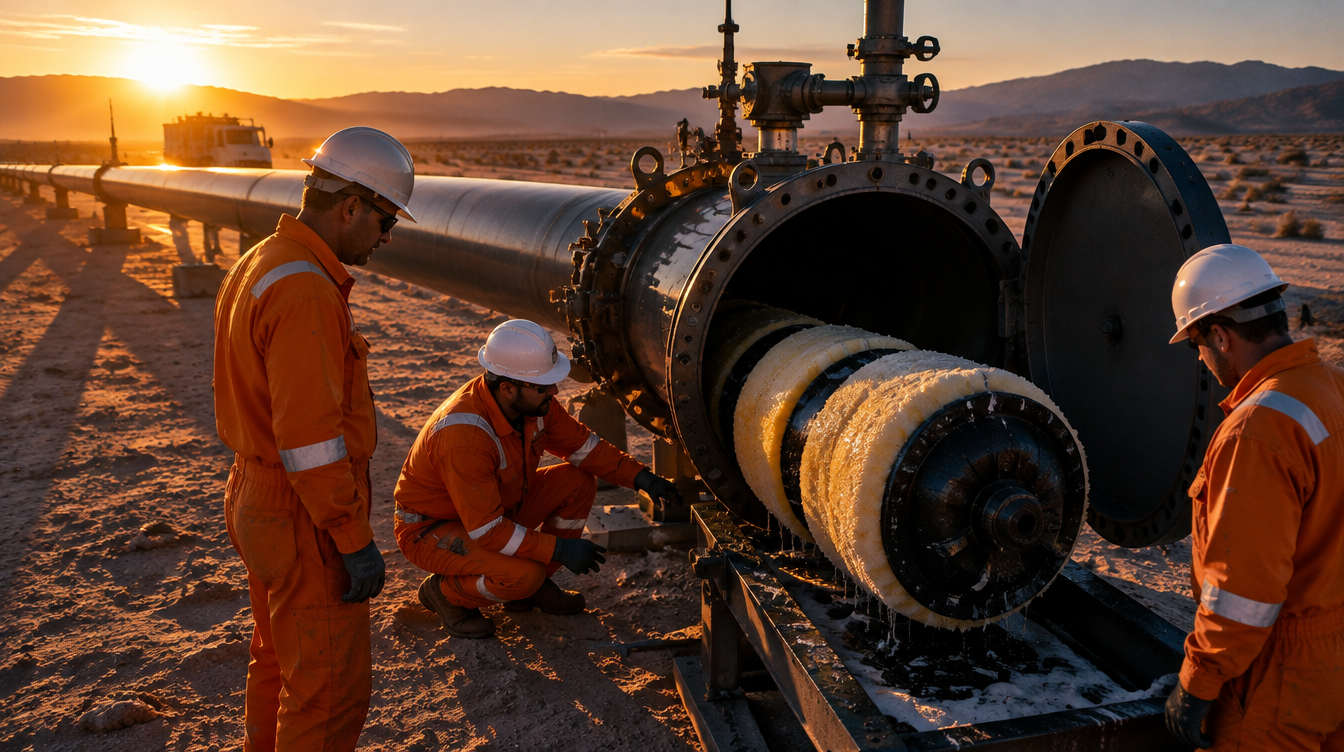
- Purging replaces one atmosphere with another; inerting keeps a system unable to form a flammable mixture.
- Displacement suits pipelines and simple geometries, while dilution suits vessels and complex piping.
- Acceptance criteria come from the operator and specification, verified with calibrated analysers at the right points.
- Nitrogen gives no warning before asphyxiation, so vent routing, monitoring and confined space controls are essential.
Before a system containing air can safely receive hydrocarbons, the oxygen has to come out. Before a system containing hydrocarbons can safely be opened for maintenance, the hydrocarbons have to come out. In both directions nitrogen is the usual tool, and in both directions the outcome depends on numbers: how much nitrogen, delivered how, measured where, and against which target.
Purging done well is quiet and uneventful. Done badly, it leaves pockets of oxygen in a line about to receive gas, or hydrocarbons in a vessel about to be entered, and it exposes the people doing the work to a hazard that gives no warning.
Purging and inerting are not the same
Purging is the removal of one atmosphere and its replacement with another: air out and nitrogen in before start-up, or hydrocarbon out and nitrogen in before maintenance. Inerting is keeping a system in a condition where a flammable mixture cannot form, often by holding it under a nitrogen blanket at slight positive pressure. A system may be purged and then kept inerted until hydrocarbons are introduced. Treating the two as one step can lead to a system that was purged correctly but allowed to breathe air back in before start-up.
Displacement or dilution
There are two basic methods. Displacement, sometimes called plug flow, pushes nitrogen through the system so that it sweeps the existing atmosphere ahead of it with limited mixing. It suits long pipelines and simple geometries, and is often assisted by a pig or by keeping enough velocity to limit mixing at the interface. Dilution mixes nitrogen with the existing atmosphere, either by continuous flow or by repeated pressurise-and-vent cycles, lowering the concentration of oxygen or hydrocarbon with each cycle. It suits vessels, exchangers and complex piping where plug flow is unrealistic.
The choice affects how much nitrogen is needed, how long the work takes and where to measure. Dead legs, instrument connections, valve cavities and branches are where both methods struggle, and they need their own vents or specific attention in the procedure.
Measuring against the right target
A purge is finished when a calibrated analyser says so, not when the clock or the nitrogen truck says so.
Acceptance criteria for oxygen content before hydrocarbons are introduced, and for hydrocarbon content before air is admitted, are set by the operator's procedures and the project specification. They should be stated in the purge procedure for each system, and the measurement has to support them:
- Analyser type: use instruments suited to the gas being measured and the expected range, with separate oxygen and hydrocarbon analysers where both matter.
- Calibration: confirm calibration against certified gas before use and, where required, after use, and record it.
- Sample points: measure at the far end of each flow path and at dead legs, not only at the main vent.
- Stable readings: require consistent results over a defined period or across repeated samples, never a single momentary reading.
- Records: log every reading with time, location, instrument and operator to support handover.
The hazard nobody can see
Nitrogen is colourless, odourless and non-toxic, which is exactly why it is dangerous. An oxygen-deficient atmosphere gives no sensation of breathlessness before it causes collapse, and rescuers who enter without breathing apparatus can become casualties themselves. Nitrogen vented into a pit, a low area or an enclosed module accumulates and displaces air. Controls should include vent routing away from work areas, personal and area oxygen monitors, barriers and signage at vent points, and strict confined space procedures, with atmospheric testing, permits and rescue arrangements, for any vessel or space that has been purged. Normal air contains about 21 per cent oxygen; the criteria for safe entry are set by the operator and local regulations.
Drying with nitrogen
Dry nitrogen also removes moisture, which matters after hydrotesting and before gas service, where residual water risks hydrates and corrosion. Drying is judged by dew point, measured with a calibrated hygrometer at the outlet against the value in the specification. As with oxygen, readings should be stable over time, and a soak period with the system closed, followed by re-measurement, shows whether moisture is still evaporating from low points.
A safe sequence
- Confirm system boundaries, isolations, and the nitrogen supply rate and quantity.
- Write the acceptance criteria, sample points and analyser calibration into the procedure.
- Set up vent routing, exclusion zones and oxygen monitoring for personnel.
- Purge by displacement or dilution, including dead legs and branches.
- Verify with calibrated analysers until stable readings meet the criteria, then maintain inerting until handover.
A practical first step
Review your next purge procedure for three things: written acceptance criteria, defined sample points including dead legs, and a nitrogen hazard plan covering everyone near the vents. If any are missing, fix them before the tankers arrive. KARR's nitrogen services team can review procedures or carry out the work if support is needed.
Nitrogen purging, Inerting, Start-up safety