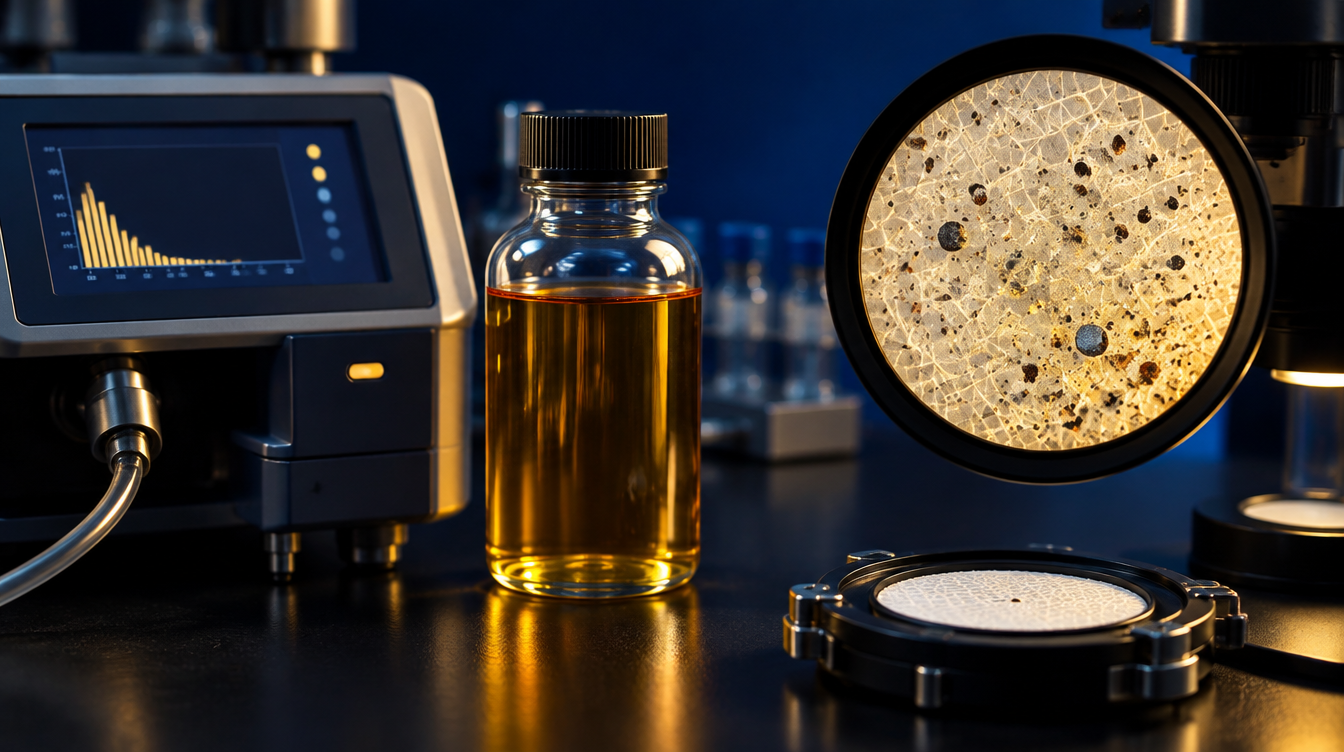
- ISO 4406 reports particles per millilitre at or above 4, 6 and 14 µm(c) as three scale numbers.
- Each step up the scale represents roughly twice as many particles, so small changes in the code matter.
- NAS 1638 and SAE AS4059 are other systems; conversions between them should be treated as approximate.
- Targets come from the OEM, specification or operator, and poor sampling can make any result meaningless.
A lube oil report arrives with a line that reads something like 18/16/13. Most people know that lower numbers are better, but fewer can say what each number represents, how much difference one step makes, or whether the sample was taken in a way that makes the result meaningful.
Cleanliness codes drive real decisions: whether a flush is complete, whether a filter is doing its job, whether a turbine can start or a gearbox needs attention. They are worth understanding properly.
What the three numbers mean
ISO 4406 describes the solid particle contamination of a hydraulic or lubricating fluid using three scale numbers. Each number refers to the count of particles per millilitre at or above a given size:
- First number: particles of 4 µm(c) and larger.
- Second number: particles of 6 µm(c) and larger.
- Third number: particles of 14 µm(c) and larger.
The "(c)" indicates that particle sizes are based on the calibration method for automatic particle counters defined in ISO 11171. Older reports may show codes based on earlier calibration methods or microscope counts, which is one reason results from different sources are not always directly comparable.
The three numbers are cumulative, so the first number includes the particles counted in the second and third. The smaller sizes tell you about silt and fine wear debris. The larger sizes are more closely linked to blocked clearances, scoring and valve sticking.
Each step roughly doubles the count
The code numbers are not particle counts. They are range numbers on a scale where each step up represents roughly twice as many particles. A fluid at 19 in a given size band therefore has about double the particles of one at 18, and about four times as many as one at 17.
This is why a change of two or three code numbers matters so much. Moving from 18/16/13 to 16/14/11 might look like a small improvement on paper, but in particle terms it represents a reduction to around a quarter of the previous count in each band. Equally, a creeping rise of one number between routine samples deserves attention rather than being dismissed as noise.
One step on the ISO 4406 scale is not a small change; it is roughly twice the dirt.
Other systems you will see
ISO 4406 is widely used, but it is not the only system. NAS 1638, developed for aerospace use, assigns a single class based on particle counts across several size ranges. It is no longer maintained for new designs but still appears on older specifications and some equipment data sheets. SAE AS4059 has largely taken its place in those applications and allows cleanliness to be specified by size range and class in a more flexible way.
The systems are not perfectly interchangeable. Conversion tables exist, but because each system uses different size ranges and counting conventions, a conversion should be treated as an approximation. Where a specification uses one system, report against that system rather than translating results after the fact.
Sampling decides whether the number means anything
A cleanliness code is only as good as the sample behind it. A poor sample can make a clean system look dirty or, more dangerously, a dirty system look clean. Good practice includes the following:
- Sample from a live, turbulent zone of the circuit while the system is running, not from a reservoir drain or dead leg.
- Use certified clean bottles suitable for particle counting.
- Flush the sample valve thoroughly before filling the bottle.
- Protect the bottle and valve from dust, sand and humid air, which takes deliberate effort on open sites in the region.
- Label each sample with location, time, operating condition and fluid temperature.
- Use a consistent method and, where possible, the same laboratory, so trends are comparable.
Online particle counters can provide continuous data and remove some handling errors, but they also need correct installation, calibration and periodic cross-checking against bottle samples. Water, air bubbles and dark or heavily additised oils can all affect optical counters, so unusual readings should be confirmed before decisions are made on them.
Where targets come from
There is no single correct cleanliness code. The appropriate target depends on component sensitivity, operating pressure, the consequences of failure and the manufacturer's requirements. Servo valves and high-pressure hydraulic systems generally need cleaner fluid than gearboxes, for example. Targets for commissioning flushes, routine operation and alarm levels are normally set by the OEM, the project specification or the operator's reliability team. They should be recorded against each system so that results are judged consistently, whoever reads the report.
A practical first step
Pick one critical system and check three things: what target code applies, who set it, and how and where the last sample was taken. If any answer is unclear, that is the gap to close first. KARR's flushing and filtration specialists can help review sampling practice or targets if that would be useful.
ISO 4406, Oil analysis, Contamination control