- Recognised codes of practice distinguish between pressure ranges, and controls should tighten as pressure rises.
- Competency should be assessed for the specific tools and tasks, with a supervisor who is not operating the gun.
- Exclusion zones must allow for the jet, hose failures, thrown debris and other trades working nearby.
- Dump and deadman controls must be function tested every time and never defeated for convenience.
High-pressure water jetting is one of the most effective cleaning methods in industry and one of the least forgiving. A water jet at operating pressure can penetrate skin and cause serious injury that looks minor at first, and a whipping hose or uncontrolled lance can hurt people well outside the immediate work area. Most incidents are not caused by exotic failures. They come from rushed setup, unclear communication or someone standing where they should not.
A competent contractor spends a large share of each job preparing before any water flows. Here is what that preparation should look like, and what clients should expect to see when they visit the work area.
Know which pressure class you are working in
Water jetting covers a wide range, from lower-pressure washing to ultra-high-pressure cutting and hydrodemolition. Recognised codes of practice, such as the WJTA-IMCA recommended practices and equivalent industry guidance, distinguish between pressure ranges and set controls that tighten as pressure rises. The specific thresholds are defined in those documents and in the operator's own procedures. What matters on site is that the contractor knows which range the job falls into, that the pump, hoses, fittings and tools are all rated for it, and that the controls match.
Competency is more than a certificate
Operators should be trained and assessed for the equipment and the task, not just hold a general card. Ask how the contractor assesses competency for specific tools such as rigid lances, flexible lances, rotating nozzles or automated systems. A good team includes a supervisor who has done the work, has the authority to stop it, and is not also operating the gun. New team members should work under close supervision until they have demonstrated the skills on comparable jobs.
Set up the zone before the pump starts
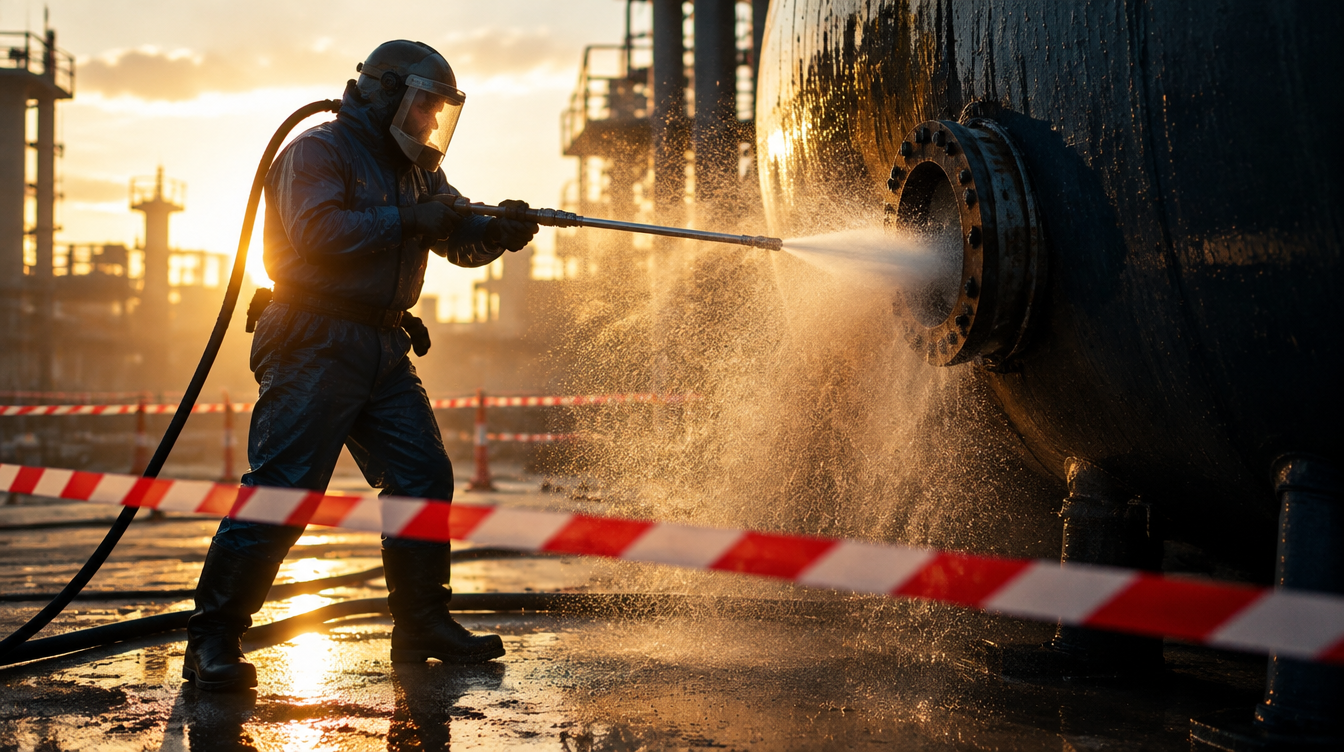
The work area should be barriered and signed so that only the jetting team can enter. The exclusion zone must allow for the jet itself, hose failures and debris thrown back from the surface being cleaned. On open plant sites this often means coordinating with other trades working nearby, and on elevated platforms it means protecting the levels below. Drainage and run-off should be planned so that water and removed material do not create slip hazards or reach places they should not.
The safest shot is the one that was planned before anyone picked up the gun.
Check the equipment, every time
Pre-use checks should be documented and carried out by someone who knows what a worn fitting or a damaged hose looks like. The key items are:
- Hoses and fittings: inspect for abrasion, kinks, bulges and damaged threads, and confirm ratings and that whip restraints are fitted where required.
- Nozzles and lances: check for wear and blockage, and confirm the correct nozzle for the task and pressure.
- Dump and deadman controls: function test every control that stops or dumps pressure, and confirm it fails safe when released.
- Pump unit: verify that pressure relief, gauges and emergency stops work, and that the unit is positioned clear of the jetting area.
- Anti-withdrawal devices: fit and check these wherever flexible lancing is used inside tubes or pipes.
Deadman controls deserve particular attention. The operator must be able to release pressure instantly, and nobody should defeat or tie down a control to make the work easier. Any sign that this is happening is a reason to stop the job and reset.
PPE and communication
Personal protective equipment for jetting is specialised. Suits, gloves, boots and face protection should be appropriate to the pressure class, and they should be inspected before each shift. PPE is the last line of defence and does not make up for weak controls elsewhere. In hot climates, the weight and heat of protective suits must be managed with rotation and hydration plans so that fatigue does not erode attention.
Jetting is noisy, so communication needs to be agreed in advance. Before the first shot, a competent crew will:
- Hold a toolbox talk covering the task, hazards, exclusion zone and emergency arrangements.
- Agree hand signals or radio protocols between the operator, pump operator and standby person.
- Confirm who controls the pump and who can call a stop at any time.
- Pressurise gradually and check the system for leaks from a safe position, never by touching or handling pressurised hoses and fittings, before starting work.
- Confirm the first aid arrangements, including how a jetting injury will be described to medical staff.
That last point is often missed. Injection injuries need prompt specialist treatment, so many contractors issue a medical alert card that explains the risk to clinicians who may not see such injuries often.
A practical first step
Ask your current or prospective contractor to walk you through their pre-jetting checklist and show you the last few completed copies. The quality of those records tells you a lot about what happens when nobody is watching. KARR's industrial services team is glad to share how it approaches jetting preparation if that would be useful.
Hydrojetting, Site safety, Contractor management