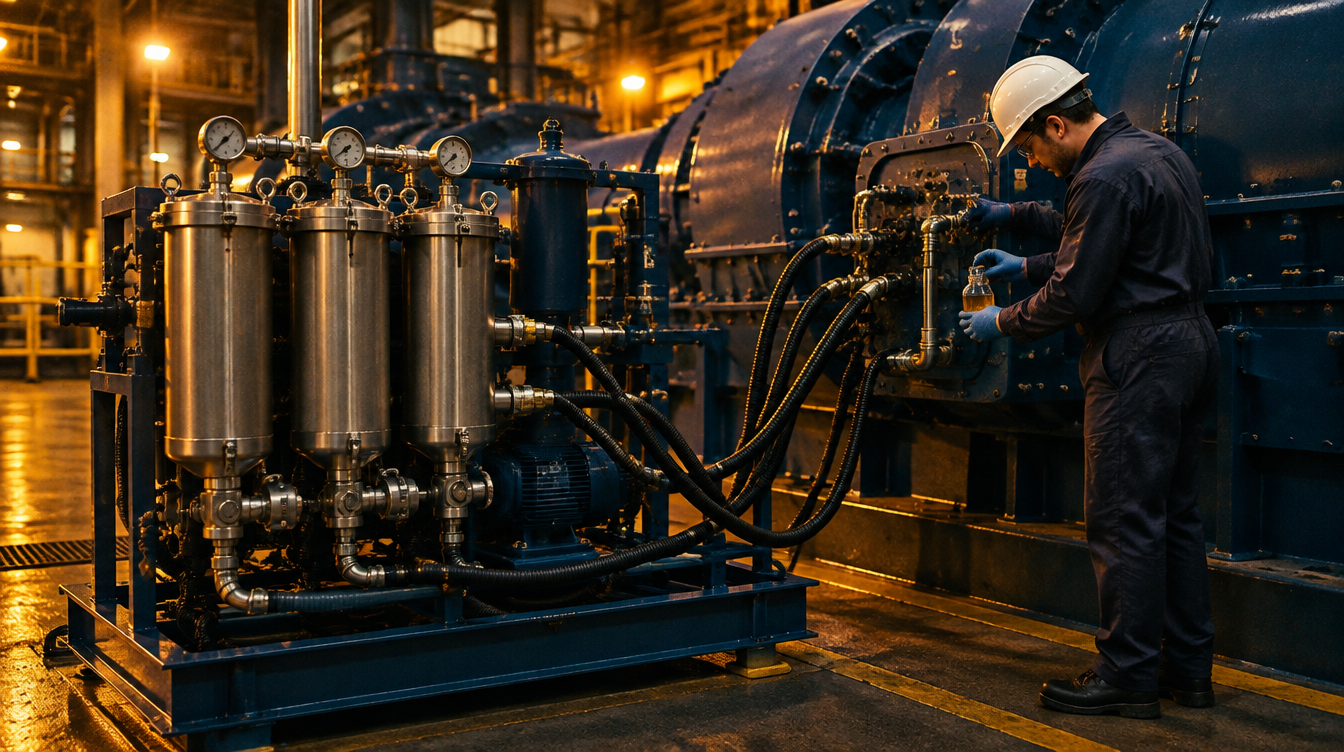
- Weld spatter, scale, sand and moisture left from construction travel straight to bearings, seals and servo valves.
- Effective flushing needs turbulent flow, described by the Reynolds number, which normal operating flow rarely achieves.
- Temporary jumpers, component bypasses and staged filtration let each circuit be flushed hard without risking sensitive parts.
- Acceptance criteria come from the OEM or specification, and sampling technique determines whether results can be trusted.
A new compressor, turbine or hydraulic power unit can be damaged in its first hours of running by debris left in the pipework during construction. Weld spatter, grinding dust, mill scale from carbon steel spools, sand blown in on site and fibres from rags all find their way into lube and hydraulic systems. Once the pumps start, that material is carried straight to bearings, seals, servo valves and gear meshes.
Pre-commissioning flushing exists to remove it. It is often seen as a box to tick before handover, but the quality of the flush has a direct bearing on how reliably the equipment runs for years afterwards.
Where the contamination comes from
Construction contamination is the obvious source. Fabrication and installation leave particles in pipe bores, fittings and reservoirs, and every flange opened on site invites more. In desert and coastal environments, wind-blown sand and humid air add to the problem, particularly where pipe ends are left uncapped during long construction programmes.
Other sources are less visible. Preservation oils and coatings applied at the factory may not be compatible with the service fluid. Water left behind after hydrotesting can cause corrosion and leave moisture in the system. In systems that have sat idle, oil degradation can begin to form varnish on internal surfaces, which may later release particles or cause valves to stick. Each of these needs to be considered when the flush is planned.
Why velocity and turbulence matter
Simply circulating oil through the system at normal operating flow does not clean it well. At low velocities, flow near the pipe wall is smooth and layered, and particles sitting in the bore or trapped in fittings are left undisturbed. A flush needs turbulent flow, where the fluid mixes chaotically and scours the internal surfaces.
Engineers use the Reynolds number to describe this. It relates fluid velocity, pipe diameter and viscosity, and it indicates whether flow is likely to be laminar or turbulent. Raising the flow rate, heating the oil to reduce its viscosity, or both, increases the Reynolds number. The target for a given project is set by the flushing specification or the equipment OEM, and the flushing contractor should be able to show how each circuit will achieve it.
A flush that never reaches turbulence moves oil around the system without cleaning it.
Preparing the system for the flush
Most permanent systems cannot achieve flushing velocity as installed, and many contain components that should not see flushing flow at all. Preparation usually includes:
- Temporary jumpers: loops and hoses that bypass equipment and connect circuits so flow can be concentrated through each section in turn.
- Bypassing sensitive components: bearings, servo valves, actuators and instruments are isolated or removed and replaced with spool pieces.
- Flushing rig: an external pump skid sized for the required flow, often with heaters to lower viscosity.
- Filtration stages: coarse filtration to capture bulk debris early, followed by progressively finer elements as the system cleans up.
- Sampling points: fitted in turbulent sections of the circuit so samples represent the fluid actually in motion.
Where the procedure allows, pipe vibration or tapping can help dislodge particles from welds and fittings. Temperature cycling may also be used to expand and contract pipework so that trapped debris is released into the flow.
Running the flush and proving it is clean
A well-run flush follows a clear sequence:
- Review the flushing procedure against the OEM requirements and the project specification, including fluid type and acceptance criteria.
- Install jumpers, blanks and the flushing rig, and confirm that all sensitive components are isolated.
- Flush each circuit in turn at the required velocity, changing filter elements as differential pressure rises.
- Take samples at defined intervals and analyse them for particle count, and for water content where required.
- Continue until results meet the acceptance criteria for the required number of consecutive samples.
- Reinstate the system, record all results and hand over with a signed flushing certificate.
Acceptance is normally expressed as a cleanliness code, such as an ISO 4406 rating, and is set by the OEM or the project specification. Sampling technique matters as much as the target. Clean bottles, proper flushing of the sample valve and consistent sampling points all affect the result. A poor sample can declare a dirty system clean, and that error only shows itself after start-up.
Once the flush is accepted, keep the system closed. Reinstating components carelessly, or leaving the reservoir open while other trades finish nearby, can undo days of work in minutes.
A practical first step
Before your next project reaches mechanical completion, check that the flushing procedure states the target cleanliness, the method of achieving turbulent flow for each circuit and the sampling plan. If any of those are vague, it is worth resolving them early. KARR's flushing and filtration team can review procedures or support execution if you need support on site.
Oil flushing, Commissioning, Lubrication